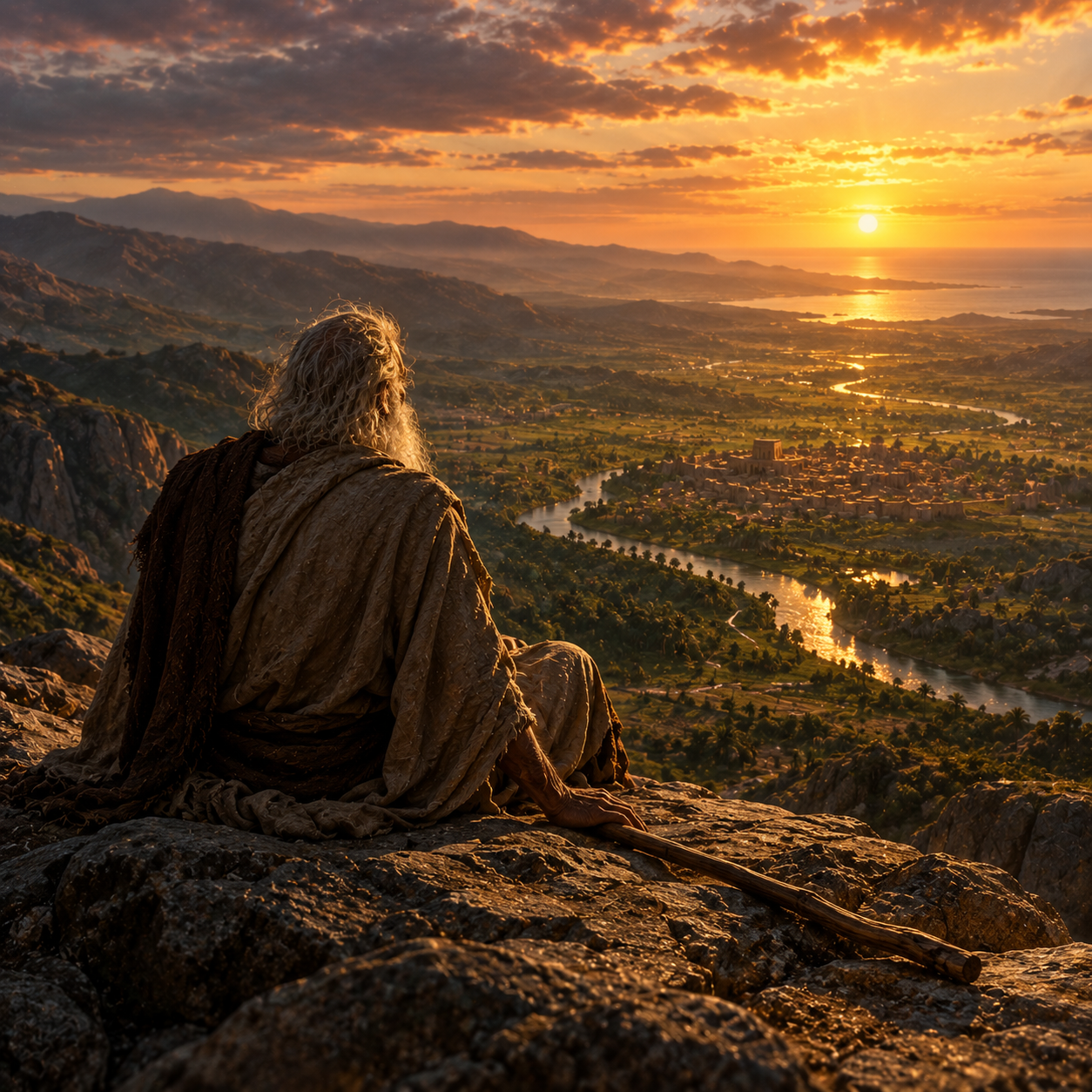
Moses led a nation for forty years and stopped one mountain short. From the top of Nebo, God shows him the whole land of promise — Gilead, the river, the palms of Jericho, the sea beyond — and tells him plainly: I have caused thee to see it with thine eyes, but thou shalt not go over thither (Deuteronomy 34:4).
The reason goes back to Meribah, where Moses struck the rock in anger and took for himself the credit that belonged to God (Numbers 20:12). In this song he isn't bitter about it. He knows what he did, and he knows that no one crosses over clean. His work was to bring them to the door, and someone else would lead them through it.
He is 120 years old, but Deuteronomy insists that his eye was not dim, nor his natural force abated (34:7). The climb nearly breaks him, and at the top his sight comes clear.
What happens next has no parallel in scripture. There is no crowd and no funeral. God buries him personally, and no man knoweth of his sepulchre unto this day (34:6). The song remembers who those hands belong to. At the beginning of the record, they knelt in the red dirt and shaped the first man. Here they kneel and lay this one down. Scripture says he died according to the word of the Lord, literally at the mouth of the Lord, and an old Jewish tradition reads that as God taking his soul with a kiss.
He dies facing the land, his feet toward the door he wouldn't walk through. The record ends Act I with the line he leaves behind: the story doesn't end with him. It never does.